How does the Impact & Insight Toolkit align with ACE’s Strategic Framework and what does that mean for you?
ACE’s new Strategic Framework
If, like us, you’ve spent some time reviewing Arts Council England’s Strategic Framework (May 2026), you’ll have noticed three key objectives that underpin ACE’s investment priorities. Investment made by ACE must:
- Support excellence
- Deliver for everybody
- Reach everywhere
The Strategic Framework builds upon the previous strategy, Let’s Create. It considers, amongst other things, feedback achieved through Margaret Hodge’s Independent Review of ACE.
Importantly, ACE acknowledges that ‘excellence looks different in different contexts’.
Excellence might mean that your work challenges established beliefs, or that it has been developed with rigour. Alternatively, it might mean that it brings joy to those that experience it, or results in people wanting to engage with further creative experiences… No one definition of ‘excellence’ is more valid than any other. What matters is having a clear definition of what excellence means to you and a robust way of measuring and evidencing it.
So, we ask you, what does ‘excellence’ look like for you, your organisation and your arts or cultural programme? And how do you evidence that you are meeting your definition of ‘excellence’?

Image credit: Adam Miller on Unsplash
How does this Strategic Framework relate to the Impact & Insight Toolkit?
The Impact & Insight Toolkit was initially established to support organisations to develop their programmes and demonstrate their commitment to the Ambition and Quality Investment Principle (IP). There is clear alignment between this IP and the first objective surrounding excellence. Both encourage organisations to articulate what matters most to them and then gather evidence to measure this. The obtained and analysed data can then be used to:
- Understand audience experiences
- Develop arts/cultural offers in line with organisational aims
- Strengthen public advocacy and communications
- Support funding applications and reporting
To support you in stating what matters to your organisation (your definition of ‘excellence’), surveys built as part of the Toolkit can contain a variety of inbuilt questions, including:
- Experience questions
- Outcome questions
- Demographic questions
You can also use the inbuilt questions to learn who you are reaching and where they’re situated, evidencing where you are contributing towards ACE fulfilling their two other objectives: Deliver for everybody; Reach everywhere.
Depending on the exact questions used, there is a variety of automated analysis and reporting options available to you. These tools enable you to present your data in a fashion that is useful to include in board meetings, advocacy materials, funding applications and in catch ups with your Relationship Manager/ACE contact.
Key reporting features include:
- Opportunities for benchmarking your quantitative results
- Obtaining summaries of your free-text results
- Interactive charts, enabling comparisons of data
Using the benchmarking capabilities in the Reporting Dashboard enables you to compare your results to some standardised questions with large datasets. Depending on the specific questions used, you might be able to compare your results against:
- Those working in a similar artform
- Those with the same variety of Arts Council funding (e.g., NPO)
- Open-source data from the Office of National Statistics
- Results from your previous evaluations
Through your participation in the Toolkit project and using the available analysis tools, demonstrate the extent to which you are meeting your own definition of excellence, while also understanding how representative your respondents are of the community where you work.
Look at our guidance on the Reporting Dashboard for more information.
Survey questions available in the Toolkit
First and foremost, we cannot write this blogpost without mentioning the outcome related question (AKA dimension) titled ‘Excellence’.
This relates directly to the ‘excellence’ investment priority and, if this is something you want to heavily lean into, we encourage you to consider adding the ‘Excellence’ dimension to your surveys. You might feel it is valuable to receive data on this from everyone that experiences your work. Alternatively, it might be that you choose to only use this question when obtaining peer reviews. The choice is yours!
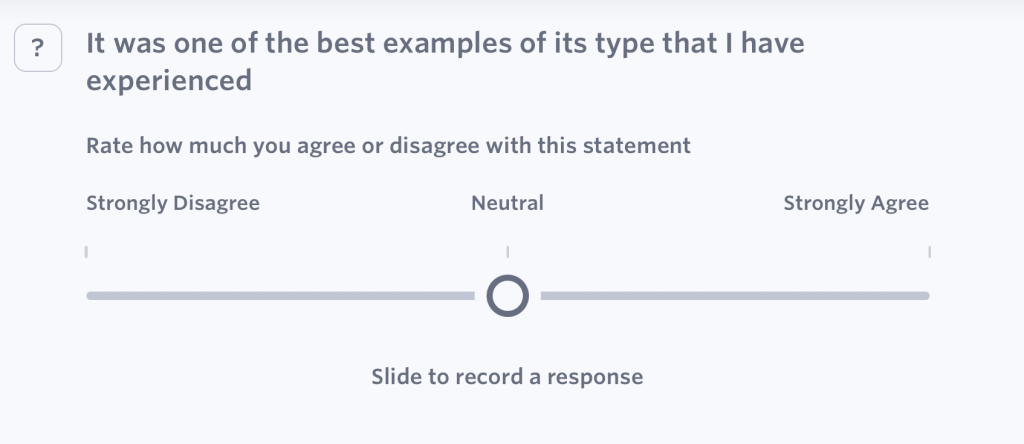
Of course, there are many other questions that will help you evidence your contribution to ‘excellence’, depending on what ‘excellence’ means to you and your organisation.
An example of an ‘excellence’ related experience question to the Toolkit is:
![Question title - Overall experience (Linguistically Easy Read) Question text – How good do you think [it]* was overall? Answer options – It was amazing; It was good; It was okay; It was bad; It was terrible](/app/uploads/2026/06/Overall-experience-Linguistically-Easy-Read-300x265.png)
An example of a further ‘excellence’ related outcome question (AKA dimension) is going to be specific to whichever organisation is delivering the surveys, and the experience they’re evaluating. However, one might be:
![Question title - Insight (Linguistically Easy Read) Question text – I learned something new because of [it]*. Answer options – A Likert scale, from 0 to 1 (to 2 decimal places), where 0 is ‘strongly disagree’ and 1 is ‘strongly agree’.](/app/uploads/2026/06/Insight-Linguistically-Easy-Read-300x195.png)
If a key element of ‘excellence’ is related to the demographics of those experiencing your work, you might want to use an inbuilt demographic question. For instance, this might be:
![Question title - Gender (Linguistically Easy Read) Question text – What is your gender? Answer options – Man/boy; Non binary. Non binary means you don’t see yourself as a man or a woman; Woman/girl; I don’t want to answer this question; I have a different gender – please tell us [free text space included]](/app/uploads/2026/06/Gender-Linguistically-Easy-Read-300x259.png)
Surveys are also an excellent mode to obtain data which will support ACE in achieving their other two objectives: ‘Deliver for everybody; Reach everywhere’. When doing this, you might want to look at the following experience, outcome, and demographic questions:
An example of an ‘everybody; everywhere’ related experience question to the Toolkit is:
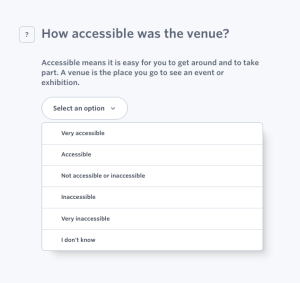
An example of an ‘everybody; everywhere’ related outcome question (AKA dimension) might be:
![Question title - Access (Linguistically Easy Read) Question text – [It]* gave me a chance to do things I can’t normally do. Answer options – A Likert scale, from 0 to 1 (to 2 decimal places), where 0 is ‘strongly disagree’ and 1 is ‘strongly agree’.](/app/uploads/2026/06/Access-Linguistically-Easy-Read-300x178.png)
Using an inbuilt demographic question will help you to ascertain who you are reaching and where they’re situated, directly relating to the ‘everybody; everywhere’ objectives. For instance, this might be:
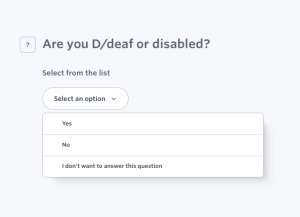
Please know that the examples above are those inbuilt to the Impact & Insight Toolkit. When building surveys in Culture Counts, you are very welcome to write your own fully customised questions. We usually find that a combination of customised and standardised survey questions works best (read more here!). That way, you can find a happy medium, where both benchmarking and analysis show your contribution to ACE’s three objectives for their investment:
- Support excellence
- Deliver for everybody
- Reach everywhere
Remember that, once you have your results, you are welcome to benchmark yours against other organisations that are participating in the Toolkit project. This is helpful to understand where you ‘sit’ in comparison to other organisations. It adds a lot of richness to the numerical results you receive and is helpful when discussing your results at board meetings and with ACE too.
You can find benchmarks on the Reporting Dashboard.
Closing Thoughts
Here at CWC, we welcome this emphasis on ‘excellence’. There is no doubt that the sector is full of excellence, yet it has been notoriously challenging to measure and evidence. Using surveys to gather data that aligns with this will be one piece of the puzzle in which you have evidence to communicate your excellence. Other examples might include: observational evidence, anecdotal evidence, longitudinal data…
Using inbuilt, standardised questions within your surveys will achieve quantitative data that can be communicated via a shared language with others in the sector, both peers and funders.
Remember to survey audience members, peers and those within your organisation about their experiences of your work to help you understand the extent to which you are meeting your definition of excellence from different perspectives. This ‘triangulation’ will help you to understand how your work lands and where it could be developed.
The Impact & Insight Toolkit provides questions and guidance to support you in getting the most out of your surveys, enabling you to evidence your excellence to stakeholders.
If you’d like to talk to a team member here for tailored, 1:1 guidance, we’re happy to help. Please do get in touch!
*Note – Words in square brackets can be replaced with your own to enable specificity, increasing the accessibility of the question.
Featured image credit: Joel Filipe on Unsplash